


The 4 Loyalty Program Types Every Shopify Brand Should Know
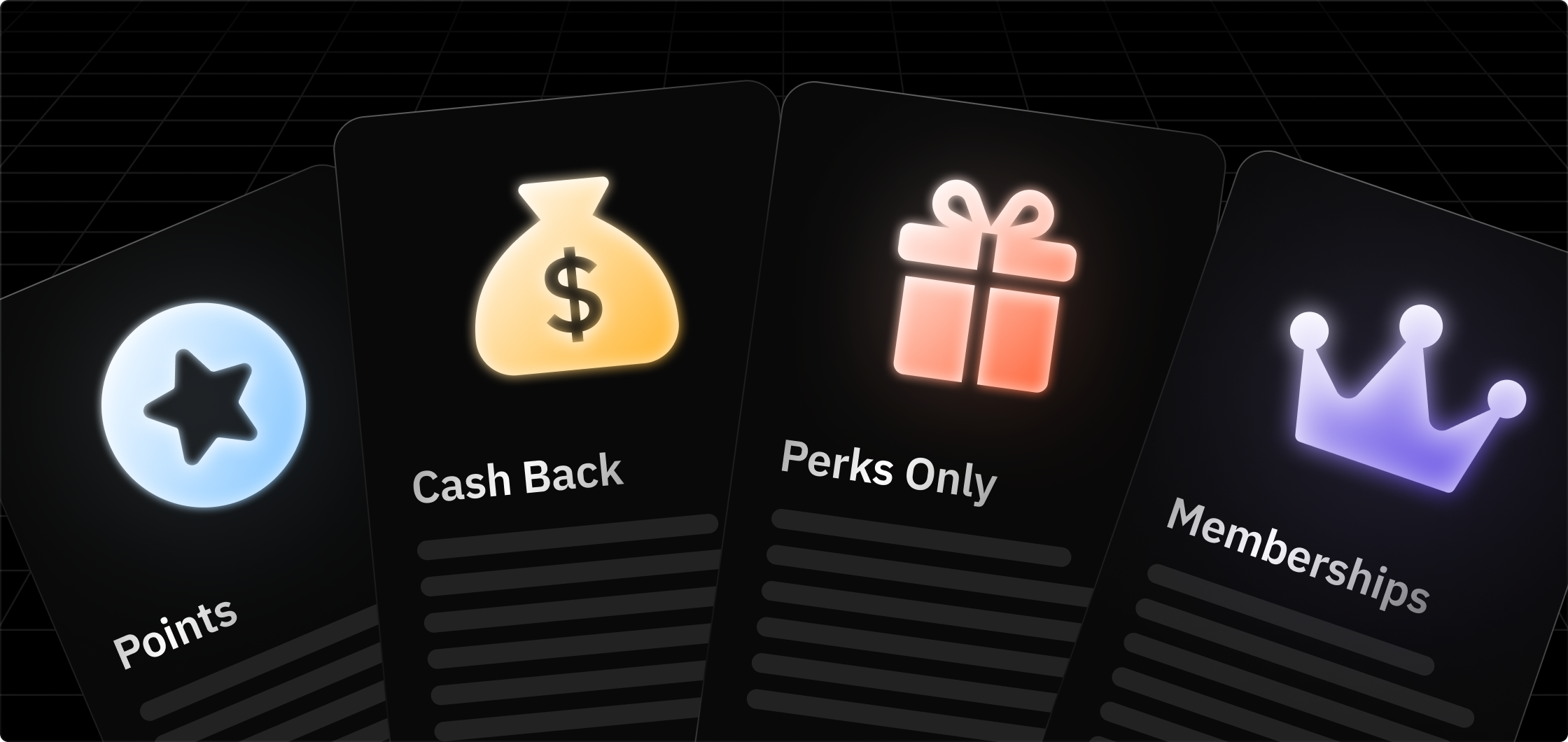
Four loyalty program types – Points, Cash-back, Perks-Only and Membership. Each one has unique advantages and limitations. Build them all with Okendo Loyalty, the most flexible loyalty program solution for Shopify brands.
If you’ve started researching loyalty programs, you’ve probably noticed the terminology gets messy fast. “Points,” “VIP tiers,” “cashback,” “rewards club”. Terms like these often get used interchangeably, but they’re not describing the same thing. Before you can design a loyalty program that actually moves your repeat purchase rate, you need to separate two ideas that many folks accidentally conflate: program type and program model.
The type is the primary form of value your members earn and it’s usually a currency like points or cashback. The model is everything built on top of that currency: your earn rules, redemption options, tier structure, and the reward mix that ties it all together. Think of the type as the fuel and the model as the engine. You can’t design the engine until you’ve picked the fuel.
Almost every successful loyalty program on Shopify is built around one of four core types: points, cashback, perks-only, and paid membership. Each has a distinct logic for why customers participate and a distinct cost structure for the brand running it. Here’s what you need to know about each before you commit to one.

Points
What it is:
Members earn points for purchases and for completing specific actions e.g leaving a review, referring a friend, signing up for SMS, and build a balance they redeem for rewards, typically discount coupons or product redemptions.
Why it works:
Points give you the widest set of levers of any program type. Because a point isn’t tied to a fixed dollar value the way cashback is, you can reward behaviors that have nothing to do with a transaction — reviews, referrals, social shares, birthdays — without touching your margin math on any given order. You can also run bonus point events and multipliers to drive urgency around a launch or a slow sales period, all without changing what a point is actually worth. There’s a quieter financial benefit too: points programs tend to see partial non-redemption, meaning some portion of the value you’ve “promised” members never actually gets claimed. That breakage often makes a points program cost less in practice than its advertised earn rate would suggest.
What to keep in mind:
That flexibility isn’t free. Points programs have more moving parts than any other type, which means more design decisions up front and more ongoing management once it’s live. The currency also has to feel worth earning. If members can’t tell what their points translate to in real value, or if the balance builds too slowly to feel rewarding, they’ll disengage before the program ever gets a chance to change their behavior. Points are the right call when you want to incentivize a broad range of customer actions beyond just spend, and when you’re willing to invest the design time to keep the mechanics clear.

Cash Back
What it is:
Members earn a cash value — usually held as store credit — that applies directly toward future orders. There’s no points-to-dollar conversion table to explain, no tiered reward catalog to browse. A percentage of what you spend comes back as credit you can spend again.
Why it works:
Cashback’s entire advantage is clarity. Customers understand it instantly because it maps to something they already know from credit cards and other retail programs — spend money, get some of it back. That intuitiveness tends to lift participation rates relative to points, because there’s no learning curve standing between signing up and understanding the value. It also reduces redemption friction: store credit applies automatically or with a single click, rather than requiring a member to browse a rewards catalog and decide what to redeem for. With fewer moving parts to manage, cashback comes closest to a “set-and-forget” program once it’s configured. If you’re optimizing for simplicity cashback is the cleanest option on the table.
What to keep in mind:
That simplicity is also its ceiling. Cashback rewards one behavior and one behavior only: spend. If part of your loyalty strategy depends on incentivizing reviews, referrals, or other engagement that doesn’t involve a purchase, cashback gives you no lever to pull. You either offer those incentives outside the loyalty program entirely, or you accept that cashback won’t touch them. For brands whose primary goal is accelerating repeat purchase with minimal operational overhead, that trade-off is usually worth making. For brands that need loyalty to do more strategic work e.g. building a review base, driving UGC, growing referral volume, a points currency will flex further.

Perks Only
What it is:
This is the type most brands don’t realize is an option. A perks-only program has no currency at all; no points balance, no store credit. Instead, members unlock benefits directly based on spend thresholds or membership tier: free shipping, early access to new products, a birthday gift, priority customer support.
Why it works:
Because there’s no currency being paid out on every order, a perks-only program protects margin in a way points and cashback structurally cannot. Your cost is contained to the perks members actually use rather than a give-back rate skimmed off every transaction whether or not the member engages further. Perks-only programs also tend to read as more premium than transactional. There’s a real positioning difference between “spend $100, get $5 back“ and “become a member and get free shipping, early access, and priority support.” For brands where heavy discounting would undercut a premium brand position, that distinction matters.
What to keep in mind:
The absence of a currency is also the absence of a lever. With points or cashback, you can dial the earn rate up or down to shift behavior e.g. run a double-points weekend, boost cashback for a slow month. With perks-only, there’s no rate to adjust. The perks themselves have to carry the entire weight of the value proposition. This model only holds up when your brand and your specific benefits are compelling enough that customers want in without being paid, dollar for dollar, to participate. It’s also structurally weak at driving non-purchase actions: with no currency to pay out for a review or a referral, perks-only programs generally have less pull for the engagement behaviors that points programs can incentivize directly.
Paid Memberships
What it is:
Members pay a recurring fee to unlock premium benefits from day one, rather than earning their way into a status tier over time.
Why it works:
A paid membership works through psychological and financial commitment. Once someone has paid to join, they’re invested from the first transaction and tend to shop more frequently to “get their money’s worth” out of the fee. That lift in purchase frequency — not the membership fee itself — is where the real value to the business comes from. A well-designed paid tier effectively pre-sells future purchase behavior. It’s also worth correcting a common misconception: paid membership isn’t only a tool for brands with an already-loyal customer base looking to monetize their superfans. It can be just as effective at accelerating repeat purchase among first- and second-time customers, by giving them a reason to commit to the brand before their third or fourth order rather than after it.
What to keep in mind:
Asking a customer to pay before they’ve experienced the full relationship with your brand is a real conversion hurdle, and it requires the perceived value on offer to clearly outweigh the fee. This model tends to work best either as a standalone offer for brands with strong repeat-purchase fundamentals already, or as the top tier of a broader hybrid structure whereby a paid tier sitting above free tiers that customers can graduate into once they’ve demonstrated engagement.
Choosing a Starting Point
None of these four types is universally “better”. Each is a different bet on what will change customer behavior at your brand, and each carries a different cost structure. Points buy you flexibility across many behaviors at the cost of design complexity. Cashback buys you simplicity and fast comprehension at the cost of only rewarding spend. Perks-only protects margin and reinforces premium positioning but removes your ability to fine-tune incentives. Paid membership manufactures commitment upfront but asks more of the customer before they’ve seen the payoff.
Many mature loyalty programs eventually blend elements of more than one type e.g a points program with a paid tier layered on top. But every hybrid still starts from a clear-eyed choice about which primary currency, if any, will anchor the member experience. Get that decision right, and the rest of the program has something solid to be built on. Get it wrong, and no amount of clever mechanics on top will fix a currency that doesn’t match how your customers actually want to be rewarded.