


The Future of Loyalty Doesn’t Have to Be Discount-Based
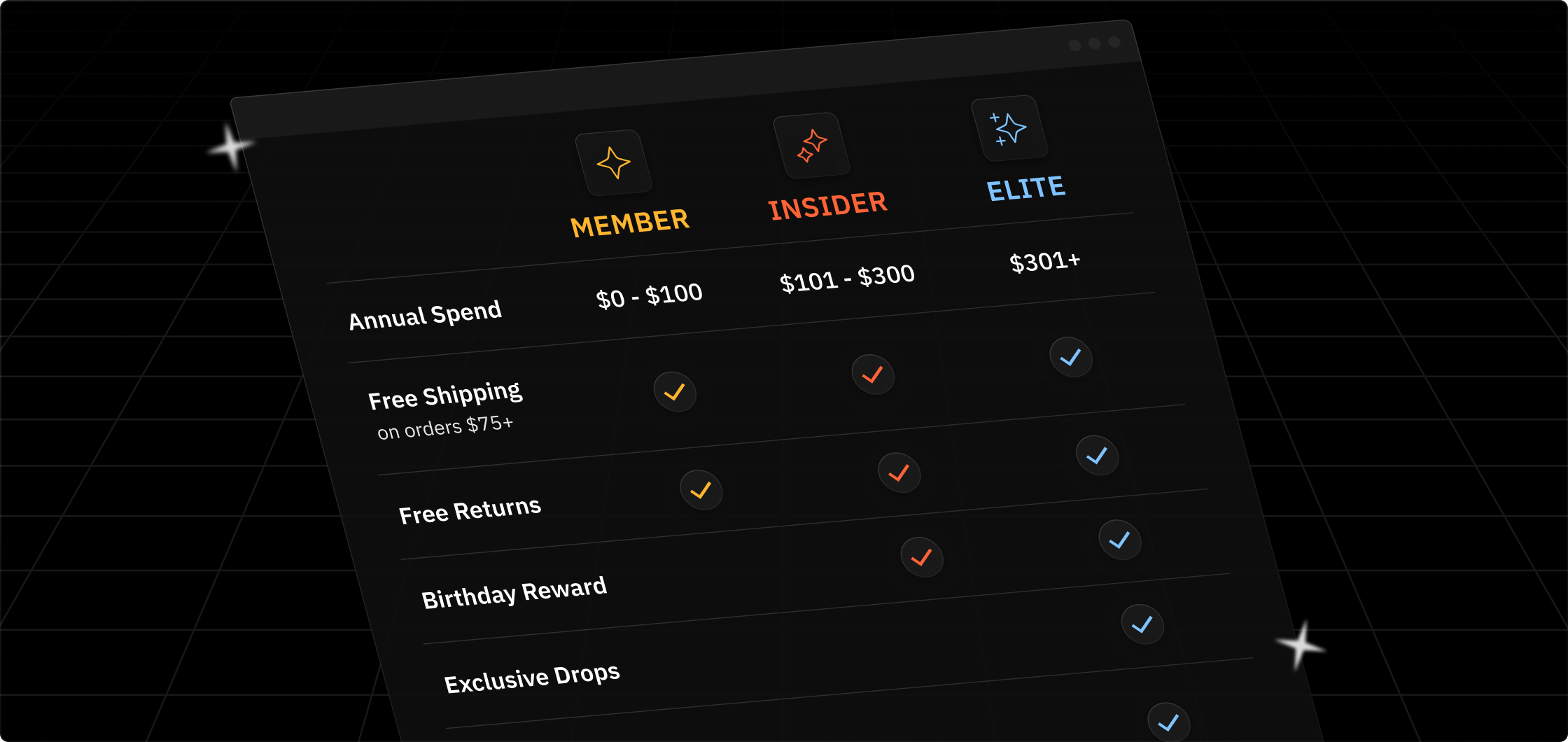
A Perks-Only loyalty program eliminates a recurring discount currency and instead offers members exclusive access to benefits such as free-shipping, exclusive sales and priority support. Perks-Only programs are a great choice for brands with a premium positioning and who do not want to offer regular discounting.
For years, “loyalty program” has been shorthand for one thing: a discount you earn slowly. Spend money, accrue points or cashback, redeem for money off. The currency might change but the mechanic doesn’t as you are, in effect, paying customers a rebate to come back.
That model still works for a lot of brands. But it carries a cost that compounds quietly on every single order: a standing give-back rate that skims your margin whether or not it changes anyone’s behaviour. And for a growing set of brands, especially those with premium positioning, tight margins, or an active community, that trade is a bad one.
There’s a fourth way, and it’s worth taking seriously as its own category rather than a watered-down version of the others. Alongside points, cashback and paid memberships, perks-only is a distinct loyalty program type. Its defining feature is what it doesn’t have: no standing discount currency at the core. And when it’s built well, it doesn’t only protect margin but can also drive the same repeat behaviour discounting was supposed to buy.
First, a quick vocabulary check
It helps to separate two ideas that often get muddled. The loyalty program type is the primary form of value that accrues to members. Most types are a currency e.g. points or cashback, but a type can also be perks-only. The program model is the complete configuration built on top of that: the tiers, the earn and redeem rules, the reward mix, the give-back economics. In other words, type is the currency; model is the blueprint.
Almost every successful program is built around one of four types:
How loyalty programs compare
| Type | Core currency | What members get |
|---|---|---|
| Points | Points balance | Earn on purchases and actions, redeem for coupons or products |
| Cash back | Store credit | A cash value that applies to future orders |
| Perks only | None | Benefits unlocked through spend and status — no balance to accrue |
| Memberships | Flexible | Premium benefits from day one, for a recurring fee |
Points and cashback share the same fundamental economics: a standing savings rate i.e. an always-on give-back earned on every qualifying purchase. That’s the engine of repeat purchase, and it’s the biggest ongoing draw on your margin. Perks-only removes that engine entirely and asks a different question: what if the reward for loyalty wasn’t a discount at all?
What a perks-program actually is
In a perks-only program, members unlock benefits through their spend and actions rather than earning points or credit to redeem later. There is no wallet filling up. There is no conversion rate to manage. Members progress and, as they do, better benefits switch on.
Crucially, this is not a flat “join and get free shipping” offer. A well-built perks-only program still has tiers with ascending benefits, the same status ladder that makes points and cashback programs motivating, minus the currency. Here’s a simple two-tier build:
| Benefit | Tier 1 (1 order/yr) | Tier 2 (5 orders/yr) |
|---|---|---|
| Free shipping on orders $75+ | ✓ | ✓ |
| Free returns | ✓ | ✓ |
| Exclusive product drops | ✓ | ✓ |
| Birthday reward | ✕ | ✓ |
| Anniversary reward | ✕ | ✓ |
| Free shipping on all orders | ✕ | ✓ |
| VIP support | ✕ | ✓ |
Notice what’s doing the work. The rewards here are not reductions in price. Instead, they’re access (early drops, priority service) and value (free shipping, free returns) based. Access rewards are typically low marginal cost but high perceived value; most are operational rather than financial outlays, which makes them efficient to scale. Value rewards enrich the shopping experience without directly lowering prices and eroding margin. Both signal something a discount never can: that you’re investing in the relationship rather than buying it.
Why brands are choosing perks programs
The case for perks-only comes down to two things: economics and positioning.
It protects margin. With no give-back rate skimming every order, cost stays contained to the perks members actually use. Contrast that with a standing discount: most DTC brands run a contribution margin between 25% and 40%, and typically reinvest 10–20% of it into retention, an affordable effective give-back of roughly 5% of revenue. Perks-only doesn’t spend that 5% on every transaction by default. You fund what gets used.
It reads premium, not transactional. A points balance trains customers to wait for a discount. For brands where discounting would undercut the positioning, that’s actively damaging. Perks-only suits brands with premium positioning or a low affordable discount rate, the ones for whom “10% off” cheapens the brand more than it helps the P&L.
There’s also a strategic tailwind worth naming. As AI assistants and agentic commerce become real discovery and purchase channels, they’ll sit between brands and customers the way social platforms did before them. In that world, the brands that win are the ones with genuine 1-to-1 relationships and engaged communities — because reviews, UGC and peer content are among the strongest signals shaping what LLMs recommend. A program built on belonging and status rather than rebates is, not coincidentally, a program built for exactly that kind of community.
Keep one thing in mind. No currency means no flexible lever. You can’t dial a rate up or down to nudge behaviour, so the perks themselves have to carry the program. This only holds up when your brand and your benefits are strong enough that customers want in without being paid to participate.
Direct rewards: instant value without a standing discount
The obvious objection is: “But sometimes I do want to hand someone something tangible — a welcome gift, a birthday treat, a referral thank-you.” You can, and you don’t need a currency to do it.
Direct rewards collapse the usual earn-then-redeem cycle into a single step. When a member completes a qualifying action, the reward is issued immediately — a free product, free shipping, store credit, or a one-time coupon. No balance, no waiting. They’re what make currency-free models like perks-only possible in the first place, and they slot naturally into the high-intent moments where instant gratification lands hardest.
Any trigger can issue any reward, so you mix them to fit the moment:
| Trigger | Direct reward |
|---|---|
| Join the program | Fixed-amount welcome coupon |
| VIP tier entry | Percentage-off coupon (capped) |
| Birthday / anniversary | Store credit or a free product |
| Successful referral | Free product (costed at COGS, not retail) |
| Challenge completion | Coupon, credit or gift |
And a direct reward can genuinely replace a discount rather than merely dressing one up. When Nutrition Warehouse relaunched its program, it swapped its new-member welcome offer from 10% off to a free gift — and watched the numbers:
| Welcome offer | Conversion |
|---|---|
| 10% off | 5.80% |
| Free gift | 6.00% |
The free gift matched the discount on conversion, drove more revenue, and saved the business over $50,000 a month in margin versus discounting. The takeaway is the whole thesis in miniature: instant, tangible value can do the job a discount was doing without the standing margin cost.
Where perks-only really comes alive: gamification
If perks-only has a natural partner, it’s gamification. Because you’ve given up the currency lever, you lean harder on engagement to drive behaviour and gamification is precisely the toolkit for rewarding participation, not just spending. It turns passive membership into active involvement, giving members a reason to do more between purchases.
It works because it stacks three behavioural drivers at once:
- Variable rewards. Uncertainty drives repeat behaviour. Surprise bonuses and mystery rewards keep members coming back to see what’s next.
- The goal-gradient effect. People push harder the closer they get to a target. Progress bars, streaks and challenges accelerate effort as the finish line nears.
- Loss aversion. Losing an earned streak or status feels worse than never having had it, so protecting it becomes its own motivation.
In a perks-only program, those mechanics do double duty. Challenges drive target behaviours and make participation fun. Badges mark status publicly on the reviews members leave, reinforcing belonging while signalling to shoppers that the brand has a real community. Leaderboards turn engagement into friendly competition and put your most active members on display. These are recognition rewards: status and inclusion rather than anything material, which makes them the single most margin-protective reward type you have. They cost almost nothing to deliver and give members exactly what a discount can’t — the feeling of being seen.
The bottom line
Discount-based loyalty isn’t dead, and for a first-order acquisition play it’s often still the right tool. But it’s no longer the only serious option. Perks-only stands as its own program type; currency-free at the core, tiered for ascending status, capable of delivering instant value through direct rewards, and at its best when gamification turns membership into genuine participation.
For the right brand, that combination does something the old model never could: it earns loyalty without renting it. And in a market where direct customer relationships are becoming the scarcest, most valuable asset a brand owns, that’s a future worth building toward.